
RGV (Rail-Guided Vehicle) vs. AGV (Automated Guided Vehicle) in Furniture Factories
An objective engineering analysis of Rail-Guided Vehicles (RGV) versus Autonomous Mobile Robots (AGV/AMR) in panel furniture manufacturing. Discover why dusty sawdust environments, 3-ton payload demands, and continuous high-speed shuttling make steel-rail RGVs the superior intralogistics choice.
The Intralogistics Dilemma in Large-Scale Woodworking
In modern panel processing plants, transporting massive 2-to-3-ton pallet stacks of melamine-faced boards, MDF, and finished door packs between primary cutting cells (beam saws / nesting CNCs), edge banding lines, buffer storage, and packaging lines represents the backbone of internal logistics.
Plant directors seeking to automate material transport typically evaluate two distinct automated transport technologies:
- RGV (Rail-Guided Vehicle): Heavy-duty motorized shuttle cars that travel on precision floor-mounted steel guide tracks, powered by enclosed busbars or high-speed trailing drag chains.
- AGV / AMR (Automated Guided Vehicle / Autonomous Mobile Robot): Free-roaming, battery-powered wheeled vehicles that navigate using magnetic floor tape, optical QR codes, or LiDAR-based Natural Feature SLAM.
While AGVs and AMRs excel in clean electronics assembly and light-duty e-commerce parcel sorting, their deployment in dusty, high-payload woodworking environments frequently encounters catastrophic operational hurdles.
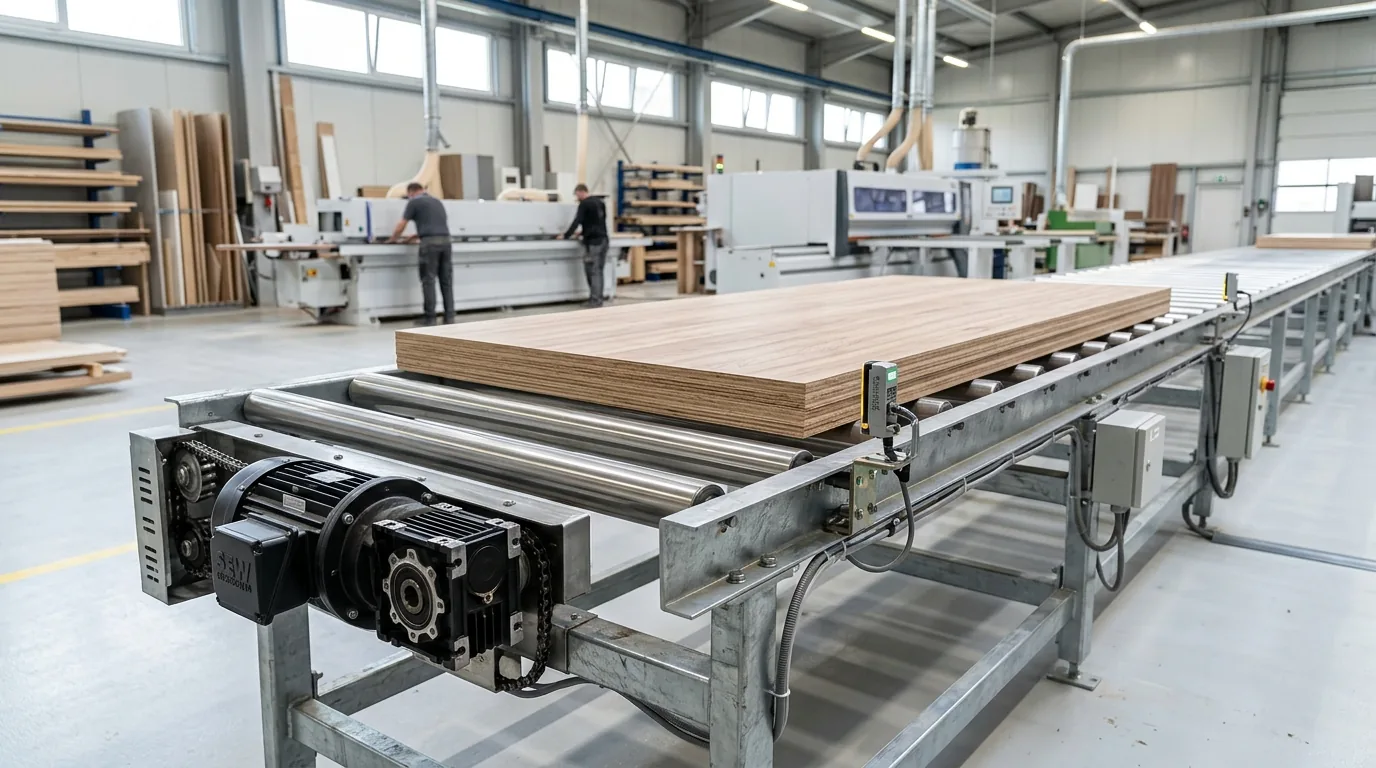
4 Reasons Why RGV Track Shuttles Outperform AGVs in Woodworking
To understand why leading cabinet and door export plants consistently favor RGV rail shuttles, let us examine the harsh physics of wood manufacturing floors:
[ AGV / AMR Dilemma in Woodworking ]
Airborne Fine Sawdust ──► Blinds LiDAR Scanners ──► False Emergency Stops
Floor Resin & Dust   ──► Obscures QR Floor Codes  ──► Robot Loses Position
3-Ton Board Load      ──► Severe Polyurethane Wheel Wear ──► High Battery Drain
[ RGV Steel-Rail Reliability ]
Fixed Steel Rail ──► 100% Mechanical Positive Guidance (Immune to Dust & Resin)
Continuous Busbar ──► Zero Battery Charging Downtime, 24/7 Full Power
Flanged Steel Wheels ──► Easily Carries 3,500kg at 80 m/min with ±1.0mm Docking
1. 100% Immunity to Wood Dust & Airborne Debris
Woodworking is inherently dusty. High-speed CNC routing and panel trimming generate clouds of airborne micro-particulates.
- AGV Vulnerability: Optical LiDAR lenses and floor-facing camera sensors become coated in fine dust within 48 hours, causing navigation “blindness” and frequent false collision stops.
- RGV Reliability: RGVs run on heavy-duty flanged steel or ductile iron wheels tracking hardened floor rails. Mechanical scrapers automatically clear sawdust ahead of the wheels, guaranteeing positive guidance without sensors.
2. Massive Payload Carrying Capacity (1 to 3.5 Metric Tons)
A full 50-sheet stack of 18 mm MDF (2440 × 1220 mm) weighs over 2,200 kg.
- AGV Limitations: Heavy-payload AGVs (2 to 3 tons) require massive chassis, quad-drive steering motors, and expensive lithium battery arrays, pushing single-unit capital costs past $85,000 to $120,000 USD.
- RGV Economics: An RGV shuttle achieves 3,500 kg payload capacity using proven structural steel beams and standard industrial helical-bevel gearmotors at less than half the equipment cost.
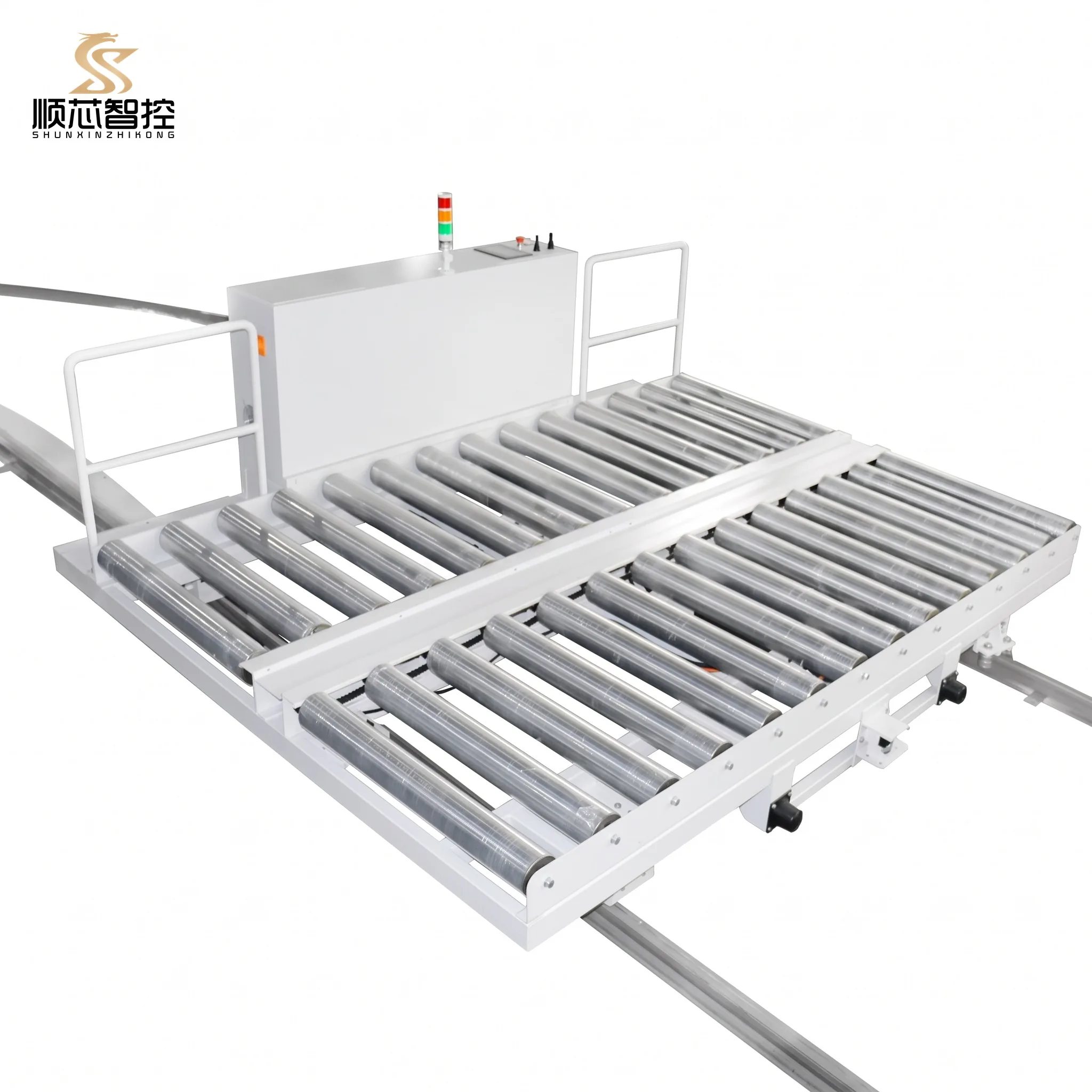
Equipped with bi-directional powered roller decks that dock seamlessly with stationary buffer conveyors, transferring 3-ton pallets in under 12 seconds.
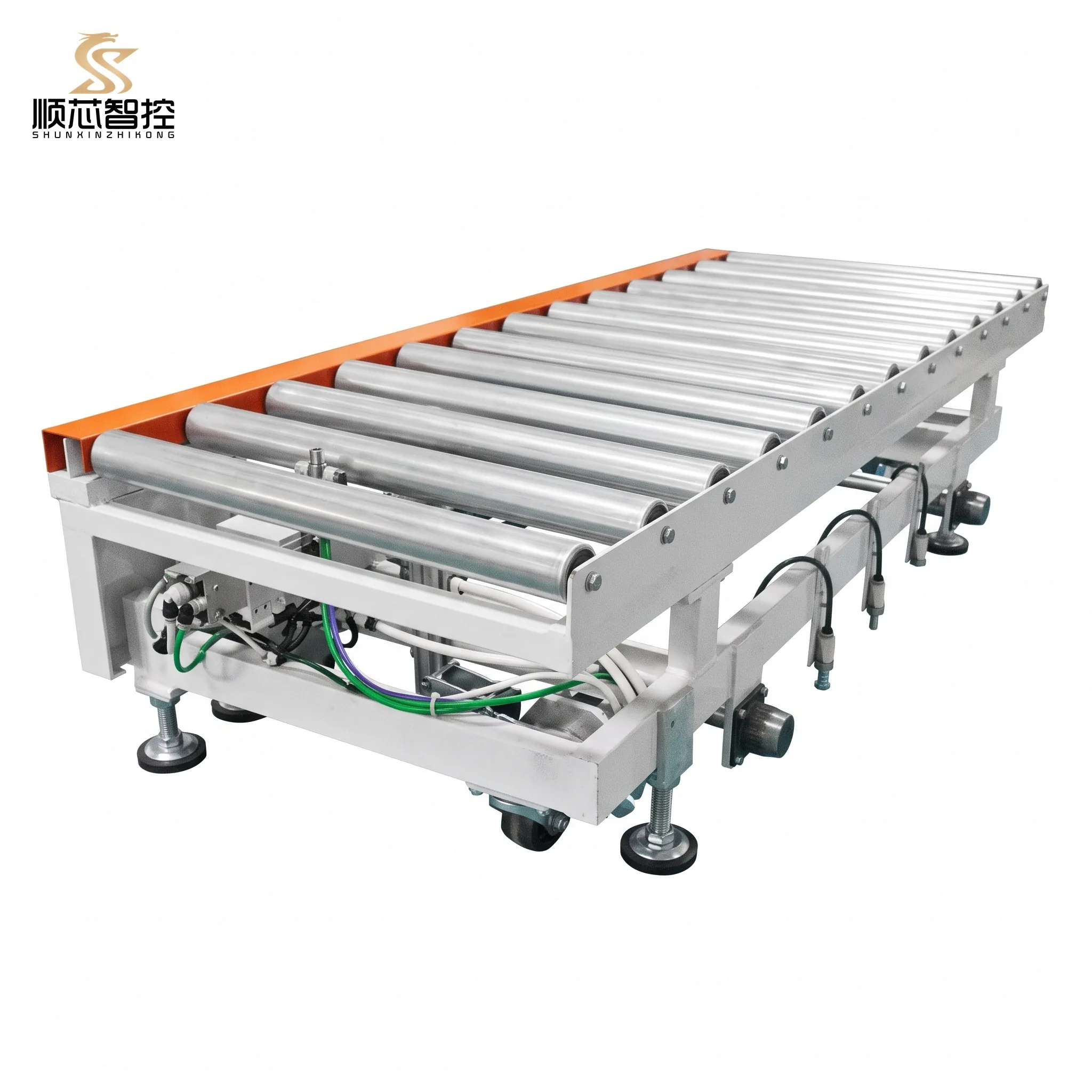
Optical infrared handshake sensors communicate between the stationary station and the moving RGV, initiating smooth synchronized board transfer upon rail docking.
3. High Shuttling Speeds & Rapid Cycle Times
Because RGV cars run on fixed physical rails with mechanical interlocks, they operate safely at speeds of 60 to 80 m/min (1.0 to 1.33 m/s) with high acceleration. Free-roaming AGVs sharing floor aisles with human workers are speed-restricted by safety regulations to 20 to 35 m/min, requiring two to three times as many vehicles to match RGV throughput.
4. Zero Battery Charging Downtime (24/7 Power Busbar)
RGVs draw continuous electrical power from an enclosed low-profile copper conductor busbar running alongside the track. They never pause for 2-hour battery recharge cycles or suffer battery degradation in unheated winter workshops.
Technical Comparison: RGV vs. AGV / AMR
| Engineering Parameter | Industrial Rail-Guided Vehicle (RGV) | Autonomous Mobile Robot (AGV/AMR) | Factory Recommendation |
|---|---|---|---|
| Max Payload Capacity | 1,500 kg – 5,000 kg (1.5 to 5 Tons) | 500 kg – 1,500 kg (Over 2T is rare/costly) | RGV for full raw board stacks |
| Operating Speed | 60 – 80 m/min (High-speed corridor) | 20 – 35 m/min (Safety limited) | RGV delivers 2.5× higher throughput |
| Sensitivity to Sawdust & Chips | 100% Immune (Steel rails with scrapers) | High (LiDAR & optical lenses get dirty) | RGV essential for woodworking |
| Docking Positioning Accuracy | ±1.0 mm (Laser / mechanical pin stop) | ±5.0 mm – 15.0 mm (Wheeled drift) | RGV required for roller-to-roller docking |
| Power Supply Method | Continuous Enclosed Busbar (24/7) | Lithium Battery (Requires charging shifts) | RGV runs continuous multi-shift production |
| Equipment Capital Cost (CAPEX) | Moderate ($28k – $45k / line) | High ($75k – $130k / robot) | RGV saves 45% in capital expenditure |
| Floor Flexibility | Fixed rail track route | Dynamic software route changes | AGV better for complex multi-branch routes |
Global Industrial & GEO Export Standards for RGV Intralogistics
Rail shuttles traversing factory corridors must meet strict international machinery safety directives:
GEO STANDARDS RGV Intralogistics Regional Compliance Matrix
- Safety Standard: ANSI/ITSDF B56.5 guided industrial vehicle safety standard
- Personnel Protection: Front and rear dual-zone laser safety scanners halt travel upon obstacle entry
- Controls: UL 508A compliant electrical enclosures, 480V 60Hz 3-Phase power busbars
<div class="p-3 rounded-xl bg-slate-900 border border-slate-800/80">
  <div class="font-bold text-white mb-1 flex items-center gap-2">
    <span class="w-2 h-2 rounded-full bg-emerald-400"></span>
    European Union (EN ISO 3691-4 Safety Directives)
  </div>
  <ul class="space-y-1 text-slate-400 list-disc list-inside">
    <li>Directives: CE Machinery Directive 2006/42/EC and EN ISO 3691-4 driverless industrial trucks</li>
    <li>Safety Architecture: Category 4, PL e safety controller monitoring brake disengagement</li>
    <li>Energy Standards: IE3/IE4 high-efficiency drive gearmotors, 400V 50Hz busbar supply</li>
  </ul>
</div>

<div class="p-3 rounded-xl bg-slate-900 border border-slate-800/80">
  <div class="font-bold text-white mb-1 flex items-center gap-2">
    <span class="w-2 h-2 rounded-full bg-amber-400"></span>
    Southeast Asia (Vietnam, Malaysia Modular Plants)
  </div>
  <ul class="space-y-1 text-slate-400 list-disc list-inside">
    <li>Power Grid: 380V, 50Hz standard Asian voltage</li>
    <li>Track Protection: Heavy zinc galvanizing on ground rails prevents oxidation in tropical humidity</li>
    <li>Throughput Target: Engineered for continuous multi-shift high-volume panel buffer distribution</li>
  </ul>
</div>

<div class="p-3 rounded-xl bg-slate-900 border border-slate-800/80">
  <div class="font-bold text-white mb-1 flex items-center gap-2">
    <span class="w-2 h-2 rounded-full bg-purple-400"></span>
    Export Packaging & Sea Transit Standards
  </div>
  <ul class="space-y-1 text-slate-400 list-disc list-inside">
    <li>Packaging: Solid timber crates compliant with ISPM-15 international export regulations</li>
    <li>Rail Packaging: Ground guide rails bundled in protective anti-scratch sleeves with desiccants</li>
    <li>Container Loading: Modular shuttle car and sectional rails pack efficiently in 40HQ containers</li>
  </ul>
</div>
Summary & Plant Logistics Layout Planning
While AGVs offer routing flexibility in clean assembly operations, the harsh reality of heavy 3-ton panel stacks, fine wood dust, and continuous production speeds makes Rail-Guided Vehicles (RGV) the most rugged, cost-effective intralogistics backbone for panel furniture factories.
Contact our intralogistics engineering team today with your facility dimensions, daily board tonnage, and station locations to receive custom 3D plant flow simulations and turnkey equipment quotations.
All automated loop return procedures and electrical sensor alignments must adhere to standard workshop lockout-tagout (LOTO) protocols and host machinery manufacturer guidelines. Shunxin equipment includes universal dry-contact interlocks to ensure immediate emergency stop response across synchronized production lines.
Need a Custom Layout Drawing & Quotation for Your Workshop?
Send us your workshop dimensions or CAD floor plan. Our mechanical engineers will deliver a synchronized layout proposal and payback calculation within 24 hours.